
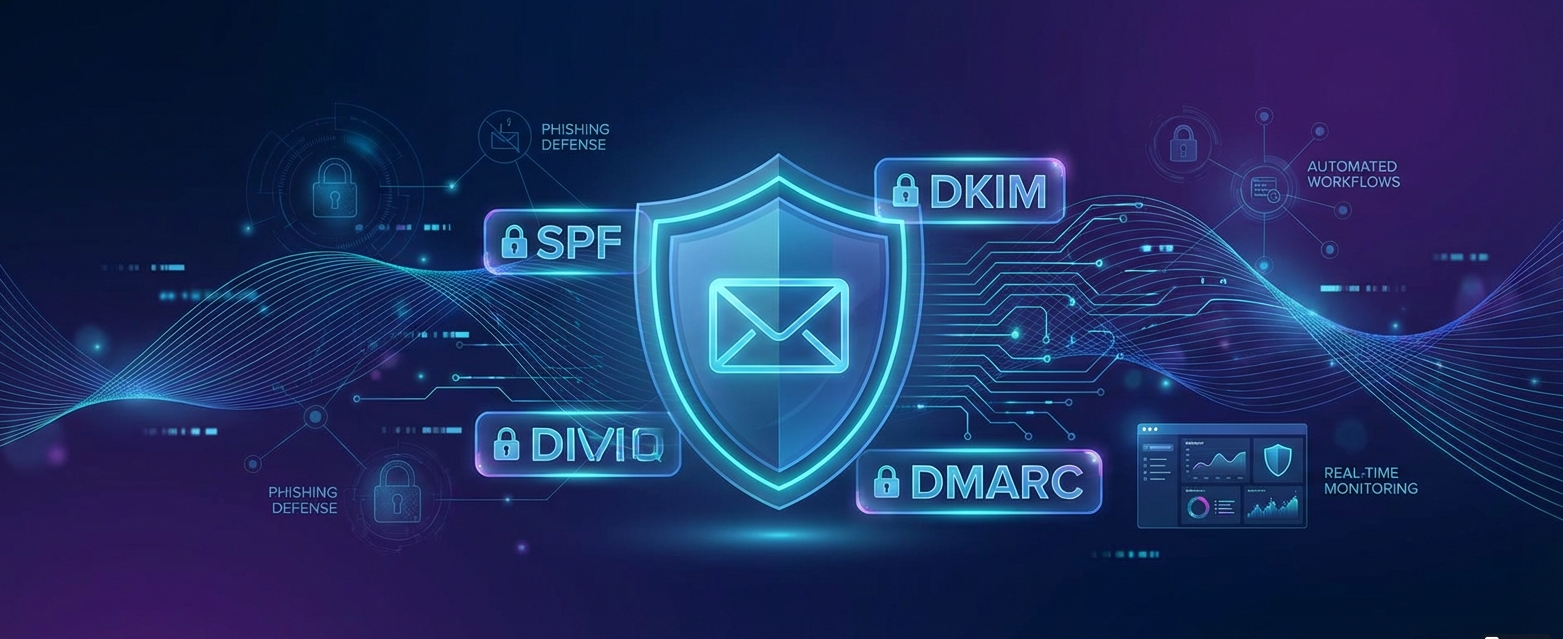
Email Protection and Sendmarc: Safeguarding Your Business Communications in 2026
Estimated reading time: 7 minutes
- Adopt strong authentication protocols such as SPF, DKIM, and DMARC to secure email communications.
- Implement end-user training to identify phishing attempts and defend against evolving threats.
- Leverage AI-driven tools for real-time monitoring and incident response.
- Centralize your security management with workflow automation for greater efficiency.
Table of Contents
- Understanding Email Protection and Why Sendmarc Matters
- Core Components of Email Protection in 2026: What Every IT Manager Should Know
- Emerging Email Threats in 2026 and How Sendmarc Helps Mitigate Them
- How AI Workflow Automation Enhances Email Security Management
- Practical Takeaways for IT Managers
- Positioning Your Organisation as a Leader in Email Security
- Conclusion: Securing Email Communication with Email Protection and Sendmarc in 2026
- Ready to Strengthen Your Email Security?
- FAQ
Understanding Email Protection and Why Sendmarc Matters
Email protection is the practice of defending email infrastructures and messages from malicious activities including phishing scams, spoofing attempts, malware infections, and data leaks. Effective protection combines strong authentication protocols, employee training, encryption, and proactive monitoring.
Among these, protocols such as:
- SPF (Sender Policy Framework)
- DKIM (DomainKeys Identified Mail)
- DMARC (Domain-based Message Authentication, Reporting & Conformance)
form the foundation of sender validation and message integrity assurance.
Sendmarc, more commonly associated with the leading DMARC platform PowerDMARC, is instrumental in enforcing DMARC policies. This platform not only validates incoming emails but also helps organisations gain visibility into their email channels, detect spoofing, and improve email deliverability by adhering to evolving provider mandates from major services like Google and Yahoo.
The combination of SPF, DKIM, and DMARC—backed by platforms such as PowerDMARC—is now an indispensable part of an email security strategy that organisations must adopt to remain resilient in 2026 (source).
Core Components of Email Protection in 2026: What Every IT Manager Should Know
The threat landscape for email systems is rapidly transforming. Cybercriminals are deploying advanced AI-driven attack vectors such as polymorphic phishing, HTML smuggling, and “quishing” (QR code phishing). These novel tactics aim to bypass conventional security measures by altering email payloads dynamically or leveraging new mediums.
Outlined below are the essential email protection practices that IT Managers should prioritise:
1. Strong Authentication and Access Control
- Use unique, complex passwords and enforce multi-factor authentication (MFA) or two-factor authentication (2FA) for all email accounts.
- Implement role-based access control (RBAC) to minimise damage from potential compromises by restricting permissions.
- Regularly audit access privileges and adapt onboarding/offboarding processes for employees.
These measures significantly reduce the risk of unauthorized access to email systems (source), (source).
2. Reliable Sender Authentication Protocols: SPF, DKIM, and DMARC
- SPF validates that emails come from authorised IP addresses, helping prevent domain spoofing.
- DKIM attaches encrypted signatures to outbound emails to ensure message integrity.
- DMARC integrates SPF and DKIM results and instructs recipient servers on how to handle failing emails, providing detailed reports for visibility and enforcement.
PowerDMARC’s DMARC enforcement capabilities empower organisations to elevate their security posture beyond basic authentication, blocking sophisticated spoofing attacks and phishing scams effectively (source), (source).
3. End-user Training and Phishing Detection
- Educate employees to scrutinise sender addresses, recognise suspicious emails, and report potential threats promptly.
- Adapt training to address evolving AI-driven phishing, including polymorphic attacks that change content to evade signature-based filters.
- Restrict email access over unsecured public Wi-Fi networks unless through VPNs.
Proactive human vigilance complements technical defences and is essential given AI’s role in threat evolution (source).
4. Encryption and Data Loss Prevention (DLP)
- Deploy TLS encryption for email transmission to protect data in transit.
- Use end-to-end encryption for sensitive communications, utilising Microsoft 365 or similar platforms.
- Implement Smart DLP tools to detect and block or encrypt outbound emails containing confidential or regulated data.
These steps ensure confidentiality and compliance with regulations such as GDPR and HIPAA (source), (source).
5. Software Maintenance and AI-Powered Monitoring
- Keep mail servers, security software, and anti-malware tools updated to patch vulnerabilities.
- Deploy AI-driven real-time monitoring tools to detect anomalous link inserts, malware signatures, and unusual access patterns.
- Employ spam filters and behaviour analytics to catch threats like HTML smuggling where malicious code assembles itself at the recipient’s side (source), (source).
6. Backups, Auditing, and Automated Response
- Conduct regular backups of critical email data and system logs.
- Audit email security configurations periodically to identify gaps.
- Use automated remediation platforms to respond rapidly to detected threats, minimising reaction times.
This holistic approach ensures resilience and continuity even in the event of incidents (source), (source).
Emerging Email Threats in 2026 and How Sendmarc Helps Mitigate Them
Polymorphic Phishing
This sophisticated threat uses AI to create dynamically changing phishing emails, altering subjects, sender addresses, and message bodies to evade traditional signature-based filters. Polymorphic phishing poses a serious risk because the malicious content adapts with every send, making static detection ineffective.
Mitigation strategies include:
- Leveraging AI/machine learning-based threat detection systems that analyse behavioural patterns over static signatures.
- Employing multi-channel monitoring beyond email – encompassing SMS and collaboration tools like Slack.
- Enforcing strict DMARC policies via platforms like PowerDMARC which provide detailed reporting and blocking capabilities to prevent domain impersonation (source), (source).
HTML Smuggling
Attackers embed malicious payloads in seemingly benign emails using HTML and JavaScript that assemble on the client side, bypassing security scanners. This method can deliver malware or ransomware stealthily.
Defences include:
- Remote Browser Isolation (RBI), where email content is rendered in a secure environment before reaching endpoints.
- Endpoint Detection and Response (EDR) tools that monitor local system behaviour post-delivery.
- Secure Email Gateways with advanced threat intelligence integration like Proofpoint or Barracuda solutions (source).
Credential Attacks and Compliance Challenges
By 2026, over 90% of credential compromise attempts will stem from phishing kits, highlighting urgency for robust protocols:
- Integrate API-based security tools for monitoring and filtering.
- Employ IP reputation filtering and biometric authentication layers for email access.
- Maintain comprehensive compliance logging to satisfy data protection laws such as GDPR and HIPAA (source), (source).
How AI Workflow Automation Enhances Email Security Management
With the increasing complexity of email threats, manual security management is no longer feasible. Automation platforms like n8n, coupled with AI-driven tools such as PowerDMARC, allow IT Managers to:
- Automate DMARC record monitoring and updates.
- Trigger alerts and remediation workflows immediately upon suspicious activity detection.
- Integrate multiple email security tools into centralised dashboards via API to correlate data and accelerate incident response.
- Strengthen compliance reporting by embedding audit data collection into automated pipelines.
By streamlining these processes, organisations can reduce human error, improve response times, and free up IT resources for strategic initiatives (source).
Practical Takeaways for IT Managers
- Implement and enforce SPF, DKIM, and DMARC protocols now to stay ahead of spoofing and phishing — leveraging platforms like PowerDMARC to simplify adoption.
- Invest in AI-powered email threat detection and behaviour analytics to combat evolving polymorphic and HTML smuggling attacks.
- Complement technical measures with ongoing staff training focused on spotting AI-assisted scams and unusual phishing tactics.
- Use workflow automation tools like n8n to automate monitoring, alerting, and remediation processes for greater efficiency.
- Ensure email encryption and data loss prevention are embedded into your communications to safeguard sensitive information.
- Regularly audit email security posture and perform simulated phishing exercises to test defences and readiness.
- Centralise your security alerts in SIEM or XDR systems to provide real-time visibility and coordinated response.
Positioning Your Organisation as a Leader in Email Security
As AI consulting experts specialising in workflow automation, our team is uniquely placed to help businesses in the UK elevate their email protection. We offer:
- Expert guidance on deploying SPF, DKIM, and DMARC with industry-leading platforms like PowerDMARC.
- Customised AI-driven workflow automation using tools such as n8n to monitor, report, and remediate email threats at scale.
- End-to-end consultancy on integrating email security into broader cybersecurity frameworks for compliance and risk reduction.
By partnering with us, your organisation will not only defend against today’s email threats but also future-proof your communication channels against emerging challenges.
Conclusion: Securing Email Communication with Email Protection and Sendmarc in 2026
Email security in 2026 demands a multi-layered approach that combines strong protocol enforcement, AI-enhanced detection, comprehensive user education, and automated response workflows. Sendmarc and similar DMARC-focused platforms play a pivotal role by providing the visibility, control, and enforcement necessary to safeguard brands and users alike.
As threats like polymorphic phishing and HTML smuggling escalate, leveraging expert consultancy and automation tools becomes imperative for IT Managers seeking to protect business communications effectively.
Ready to Strengthen Your Email Security?
Discover how our AI consulting and workflow automation services can transform your email protection strategy with PowerDMARC and n8n integration. Contact us today for a personalised consultation and take the first step towards cyber resilience in 2026.
FAQ
What is Sendmarc and how does it enhance email security?
Sendmarc is a platform that helps enforce DMARC policies to improve email security by validating incoming emails, detecting spoofing, and enhancing email deliverability.
Why are SPF, DKIM, and DMARC important?
They are essential authentication protocols that help validate email senders, ensure message integrity, and instruct recipient servers on how to handle failing emails.
How can organizations train employees to recognize phishing attacks?
Organizations can provide training that teaches employees to scrutinize sender addresses, recognize suspicious emails, and report potential threats.
What emerging threats should organizations be aware of in 2026?
Organizations should be aware of threats such as polymorphic phishing, HTML smuggling, and credential attacks, which use advanced AI techniques to bypass traditional security measures.
How can AI workflow automation improve email security?
AI workflow automation can streamline security processes by automating tasks such as DMARC monitoring, alert generation, and incident response, thus improving efficiency and reducing human error.
Book a demostration today
Comments are closed